
Introduction
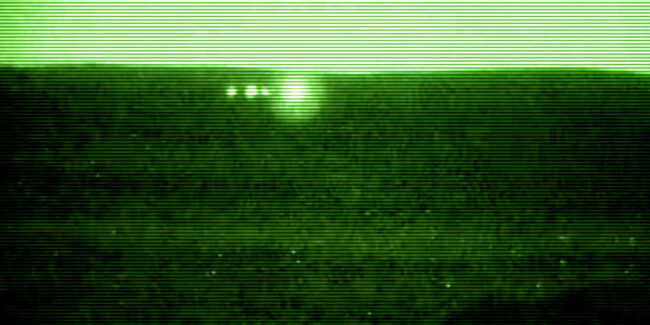
The Marfa Lights are a mysterious light phenomenon observed in the desert near Marfa, Texas, USA. They appear as glowing orbs—often yellow-orange but sometimes other colors—that hover, split, merge, and disappear over the flat open terrain east of the town. Despite more than a century of reports, the lights remain partially unexplained, sitting at the intersection of folklore, tourism, and scientific investigation.
Geographic & Historical Context
-
The lights are most often seen on the plateau known as Mitchell Flat, east of Marfa, facing the Chinati Mountains in Presidio County, Texas.
-
According to the state historical handbook, the first known historical record dates to 1883, when a cowhand named Robert Reed Ellison saw a flickering light while driving cattle through Paisano Pass.
-
Native Americans in the region also reportedly knew of “mystery lights” prior to those settler-recorded sightings.
-
In modern times, a dedicated viewing point—often called the “Marfa Lights Viewing Area” off U.S. Highway 90 about 9 miles east of town—has been established for visitors.
Description of the Phenomenon
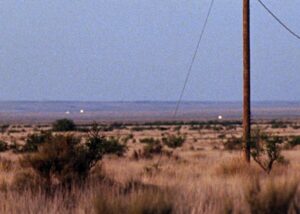
The two bright circular white lights are Marfa Lights, probably a few hundred yards away. The leftmost light is due to vehicle headlights traveling north toward Marfa on Route 67 from Presidio. Photograph by Edson C. Hendricks.
Witnesses describe the lights with the following recurring features:
-
Orbs of light, often varying in size (sometimes compared to a basketball-sized glow) that appear at or near the horizon over the flat terrain.
-
Colors include yellow-orange, red, white, sometimes green or blue.
-
Behavior: The lights may hover, drift slowly, split into multiple lights, merge, disappear suddenly, or move in erratic paths.
-
Occurrence: They are reported in various seasons, and under clear nights, though they are unpredictable.
Theories and Explanations
Many explanations have been proposed over the years—some scientific, some folkloric.
Atmospheric / Optical Illusions
-
One leading scientific explanation is that the lights are a kind of mirage (specifically akin to a superior-mirage or “Fata Morgana”) where layers of warm air over cool ground bend light rays from distant sources.
-
The phenomenon of automobile headlights some distance away being refracted or distorted has also been supported by investigations. For example, students at the University of Texas at Dallas found that during a four-night study, lights they observed corresponded with vehicle traffic on U.S. 67, and that flashing a car headlight produced a perceived Marfa-type light.
Geological / Electrical Hypotheses
-
Some researchers have suggested geophysical origins: stresses in quartz-rich rocks causing piezoelectric or plasma discharge effects, or dusty plasma gathering above fault lines.
-
For example, one local researcher suggested “underground lightning” or dusty-plasma clusters as the source.
Folklore and Paranormal Interpretations
-
Local folklore includes Native American legends and settler stories: ghost lights, spirits, campfires of Apache warriors.
-
Some believe the lights are evidence of extraterrestrial activity due to their erratic movements and sudden appearances.
- Another hypothesis has emerged that the lights may be intelligent plasmas. Also see Robert Temple’s A New Science of Heaven and Andrew Collins’s LightQuest.
-
Because the lights appear to defy simple explanation for many observers, the phenomenon has become a staple of paranormal tourism.
Scientific Investigations & Findings
-
A 2008 study at Texas State University used spectroscopy over 20 nights and found that observed lights could be explained by automobile headlights or small fires—but noted that “genuine” lights (if any) were rare.
-
The Handbook of Texas comments that while the mirage hypothesis remains most plausible, no definitive answer has yet been confirmed.
-
A research summary from EBSCO notes that though many investigations exist, “no definitive explanation has been found.”
Cultural & Tourism Impact
-
The town of Marfa capitalizes on the phenomenon: The local chamber of commerce lists the Marfa Lights as a prime attraction, and an annual “Marfa Lights Festival” held each September draws visitors.
-
The lights contribute to Marfa’s cultural identity, mixing art, mystique, desert minimalism, and tourism driven by curiosity.
-
For visitors: The official viewing area was designed with help from local high school students and the Texas Department of Transportation.
Viewing Tips & Practical Information
-
The viewing site is about 9 miles east of Marfa on U.S. Highway 90, in an area with little light pollution, ideal for night observation.
-
Clear nights are best, especially when the horizon is visible and conditions are calm. Bring a spotting scope or binoculars, warm clothing, and patience.
-
Because sightings are unpredictable, don’t expect a guaranteed display—some nights may yield nothing.
-
Consider visiting during the Marfa Lights Festival for a community event atmosphere if you time it right.
Outstanding Questions
-
Are all the lights explained by vehicle headlights and atmospheric refraction, or are there cases of unexplained lights remaining after eliminating such sources? Some researchers suggest rare “unexplained” events persist.
-
Can the behaviour of the lights (splitting, merging, hovering) be fully accounted for by known optical/atmospheric phenomena? Some eyewitness reports suggest more erratic behaviour than simple headlights.
-
What role, if any, do local geology, mineralogy, or electrical conditions (e.g., fault-lines, rock stress) play? These remain speculative.
- How much does expectation, environment (darkness, isolation), and perceptual bias influence what people report seeing?
Conclusion
The Marfa Lights remain a fascinating mix of mystery, folklore, science, and tourism. While many sightings can likely be attributed to distant headlights and atmospheric optics, a portion of the phenomenon resists full explanation—and that is part of the appeal. Whether you view them as a clever mirage or a genuine extraordinary light show, visiting the site offers a unique experience in the wide open spaces of West Texas.
Free Online Book: Hunting Marfa Lights, James Bunnell 2009